 Greenstar is proud to be an Affinity Partner of PEOPLink, an organization with goals that are parallel to ours; read the whole story below. If you're not yet familiar with Greenstar, read an introduction here. When you click on one of the PEOPLink logos below (at the beginning or the end of the article), you'll be taken to the PEOPLink website...and a commission on the proceeds will be earned by Greenstar. There are many beautiful, unique gift ideas in the PEOPLink catalog, each with a story behind it. If you'd like to put a similar link on your Web page, click here to get a short segment of HTML code, which you can insert into your website to earn Greenstar commissions.
|
 Research Note produced for CommerceNet by Gail L. Grant, June 23, 1999
The Concept The
Internet
can
allow
people
to
buy
goods
and
services
from
merchants
anywhere
in
the
world.
This
resolves
the
issues
of
channels
(how
remote
merchants
sell
their
goods
to
the
buyer)
and
distribution
(getting
the
goods
to
the
buyer
from
remote
destinations).
It
is
simply
a
matter
of
the
merchant
setting
up
a
But what about third world countries where phone lines and even electricity can't be taken for granted? PEOPLink is a non-profit that helps artisans in remote communities around the world to sell their products over the Internet. PEOPLink was founded by Daniel Salcedo and Marijke Velzeboer to facilitate ecommerce directly with producers in the developing world, eliminating the middleman and ensuring maximal profitability for the producer. This technique is more effective than traditional economic aid or charity because it allows people to build their own sustainable future, based on what they do best, and improve their quality of life using their traditional skills. Roots PEOPLink's
roots
go
back
to
1979,
with
an
organization
called
Pueblo
to
People.
Dan
Salcedo
and
Marijke
Velzeboer
were
a
young
couple
living
in
Guatemala
in
the
late
'70s.
Dan
worked
for
the
UN
and
Marijke
was
finishing
a
Ph.D.
in
public
health.
One
day
at
a
party,
While there, Marijke and Dan were impressed by well-made, sturdy palm leaf hats made by the local people. They had been thinking about trying to sell some of the crafts they had seen in Guatemala to people back in the USA and these hats seemed like an ideal starting point. Quickly, Dan realized that they needed to not sell not just the products themselves, but their context within the lives of the artisans that created them. Pueblo to People marketed crafts from artisans in Latin American to people in the USA through a mail order catalog. The organization had a very successful model of self-sustaining development that empowered the poor. Its annual sales grew to $3.5M, supporting 3,000 families in more than a dozen countries. Methods PEOPLink maintains a web site that lists the artisans' products for sale. PEOPLink buys products in bulk, so they can be shipped to customers quickly. This advance purchase allows the producer to buy raw materials and supplies for creating more items, more cost-effectively. PEOPLink takes a percentage of the sale, but the majority of the profit is passed along to the artisan.
Each trading partner provides services to several of these grassroots groups, taking pictures of the artisans at work and the products for sale. They can also answer questions about products via email. Trading partners make the link between the artisan and technology. PEOPLink supports trading partners via training -- both in person and on-line -- and email. PEOPLink equips the trading partners with digital cameras and trains them on how to use the cameras and a computer to edit the captured images and edit them in a compressed format suitable for transmission via the Internet. Examples Perhaps the best way to understand just what PEOPLink is doing and the diversity of products being sold is to look at a few examples. Guatemala: Custom Wholesale
Recently, Maximo engineered one of the largest PEOPLink sales to date. A wholesale customer was looking for green baskets at PEOPLink. He found a basket on the wholesale site that was close, but it was too big and too expensive, so an email message was sent to Maximo, to determine if it was possible to get the basket made in a smaller size and a lower price. Maximo worked directly with the producer, took a picture of a new sample to the customer's specifications and sent back an email message with the picture and a lower price. The customer was delighted and placed an order for $13,000 in baskets. "The trading partner handled this completely on his own. The first we heard about it was when he asked us to help him with translation of the email messages," Dan Salcedo, the CEO of PEOPLink explained proudly.
Uganda: Sapphire Women and the AIDS Victim fund
From this personal tragedy Helen formed two organizations: Sapphire Women and the AIDS Victim Fund. Sapphire Women produce baskets that are then donated to Helen and sold via the PEOPLink web site. There are currently about 500 women involved in production of these baskets. The women work out of their home and vary from young, unmarried teenagers to grandmothers who would like to see something done for the orphans in their village. The revenues from the sales fund the AIDS Victim Fund.
Nepal: Janakpur Women's Development Center
Traditionally, these women paint intricate designs on the mud walls of their homes for special occasions, like marriage or festivals. Typical subject matter includes animals such as peacocks, elephants and tigers, the gods and scenes from traditional folk tales. The center helped to train the women to move from the traditional mud wall as their canvas, to Iokta -- a Nepali handmade paper. The women use acrylic paint applied with brushes to create their artwork. Prior to the center's opening, few opportunities existed for Maithil women earn cash and to engage in the skills of leadership, literacy or even basic business.
PEOPLink works with almost 100 organizations in 30 countries: Bolivia, Chile, Dominican Republic, Ecuador, El Salvador, Guatemala, Haiti, Honduras, Mexico, Panama, Peru, Bangladesh, Cambodia, India, Indonesia, Nepal, Philippines, Sri Lanka, Thailand, Tibet, Viet Nam, Ethiopia, Ghana, Kenya, Morocco, Rwanda, Nigeria, South Africa, Tanzania and Uganda.
 |
 web
site
for
sales.
web
site
for
sales.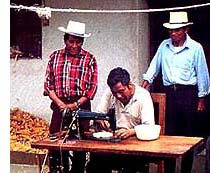 Marijke
had
a
conversation
with
the
U.S.
Peace
Corps
country
director,
who
asked
her
to
do
an
evaluation
of
a
Peace
Corps
program
in
the
highlands
of
Guatemala.
Marijke
had
a
conversation
with
the
U.S.
Peace
Corps
country
director,
who
asked
her
to
do
an
evaluation
of
a
Peace
Corps
program
in
the
highlands
of
Guatemala. PEOPLink
develops
a
"trading
partner
relationship"
with
local
non-profit
development
organizations
that
have
relationships
with
local
grassroots
groups
such
as
craft
cooperatives,
widows
groups,
refugee
associations
and
peasant
leagues.
PEOPLink
develops
a
"trading
partner
relationship"
with
local
non-profit
development
organizations
that
have
relationships
with
local
grassroots
groups
such
as
craft
cooperatives,
widows
groups,
refugee
associations
and
peasant
leagues. Maximo
Terraza
is
a
very
bright
young
Guatemalan,
but
his
parents
were
unable
to
afford
to
send
him
to
college.
His
work
with
PEOPLink
has
given
him
invaluable
training.
Maximo
supports
8-9
weaving
groups,
travelling
throughout
his
local
area
taking
pictures
of
people
doing
the
weaving
and
dyeing.
He
has
created
an
extensive
web
site
in
Spanish
for
the
groups
he
supports,
completely
on
his
own.
Maximo
Terraza
is
a
very
bright
young
Guatemalan,
but
his
parents
were
unable
to
afford
to
send
him
to
college.
His
work
with
PEOPLink
has
given
him
invaluable
training.
Maximo
supports
8-9
weaving
groups,
travelling
throughout
his
local
area
taking
pictures
of
people
doing
the
weaving
and
dyeing.
He
has
created
an
extensive
web
site
in
Spanish
for
the
groups
he
supports,
completely
on
his
own.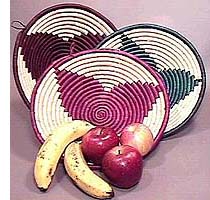 Helen
Mutono's
brother
died
of
AIDS,
and
she
was
concerned
for
his
widow
and
children.
How
would
they
survive?
Unfortunately,
Helen's
situation
is
not
uncommon.
By
the
year
2000
it
is
estimated
that
there
will
be
close
to
1
million
children
orphaned
in
Uganda.
Helen
Mutono's
brother
died
of
AIDS,
and
she
was
concerned
for
his
widow
and
children.
How
would
they
survive?
Unfortunately,
Helen's
situation
is
not
uncommon.
By
the
year
2000
it
is
estimated
that
there
will
be
close
to
1
million
children
orphaned
in
Uganda.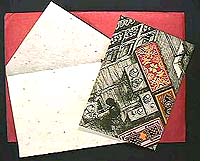 In
1989,
Janakpur
Women's
Development
Center
became
the
first
non-governmental
organization
in
Nepal
to
use
the
tradition
of
painting
for
the
empowerment
and
advancement
of
Maithil
women.
In
1989,
Janakpur
Women's
Development
Center
became
the
first
non-governmental
organization
in
Nepal
to
use
the
tradition
of
painting
for
the
empowerment
and
advancement
of
Maithil
women.